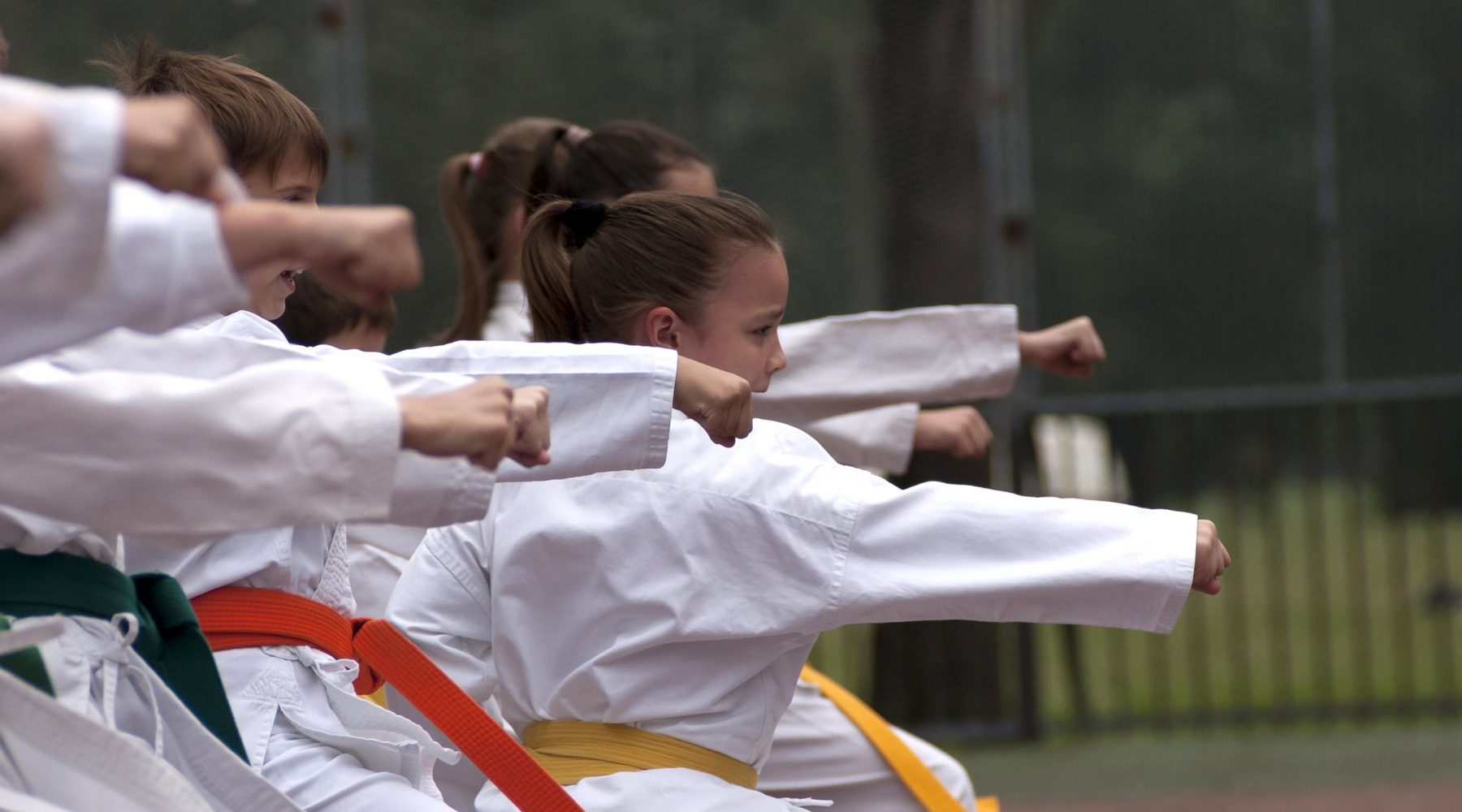
Wado Ryu Karate
The way of harmony — and the art at the heart of WYSOK
Wado Ryu is the style most WYSOK students start with, and the one the association was built on. Its name translates roughly as "way of harmony", and that is not decoration — it describes how the art actually works.
Hironori Ohtsuka was already a master of Shindo Yoshin-ryu jujutsu before he began studying karate. When he formed his own style he brought that jujutsu thinking with him, and it shows in everything Wado Ryu does differently. Where some styles meet force head-on, Wado moves off the line, redirects and counters. Stances are shorter and more natural than in Shotokan. Body-shifting — tai sabaki — and evasion do the work that raw strength does elsewhere.
The practical consequence is that Wado Ryu does not reward being the biggest person in the room. A twelve-year-old and a fifty-year-old can both train it properly, which is exactly why our clubs run mixed-grade, mixed-age sessions rather than separating everyone out by size.
A typical class works through three things: kihon, the basic techniques drilled until they stop needing thought; kata, the set forms that carry the style's principles; and kumite, controlled partner work and sparring. Alongside these we teach a wide range of defences, a number of them borrowed from Ju Jitsu. These are worked in pairs, and are where the practical self-defence side of the style is taught.
What you learn
- Kihon — the basic blocks, strikes and kicks, drilled until they are automatic
- Tai sabaki — body-shifting and evasion, the core of what makes Wado different
- Kata — set forms including the Pinan series, Naihanchi, Kushanku, Seishan and Chinto
- Kumite — controlled partner work, building to free sparring
- Paired defences — a wide range of them, some borrowed from Ju Jitsu, worked with a partner and aimed at practical self-defence
- Distance and timing — reading an opponent rather than out-muscling them
Who it suits
Almost anyone. Because Wado relies on timing and positioning rather than size or power, it works as well for a small child as for an adult returning to training after twenty years off. It suits people who want a traditional art with a proper syllabus and grading structure, and who like the idea of getting better through precision rather than through getting stronger.
Grading & belts
Students work through kyu grades, marked by coloured belts, from white up to brown. Gradings run roughly every three to four months across the association, and your instructor will tell you when you are ready — nobody is pushed forward before they are. Beyond brown belt come the dan grades, which take years rather than months. Several WYSOK instructors hold 5th Dan and above.
Your first session
Come in a T-shirt and jogging bottoms with a bottle of water — no suit, no equipment, nothing to buy. Your first session is free, you pay per session after that, and there is never a contract. Pick the club nearest you below and message the instructor directly.
13 clubs teaching Wado Ryu Karate


Try Wado Ryu Karate for free
Find your nearest club, message the instructor directly, and turn up. That is the whole process.