Confidence first. Belts second.
Our Pee Wee and junior classes run separately from the adult sessions, in shorter blocks pitched at the attention span of the age group in the room.
A first class, from the door
Most parents arrive expecting shouting and press-ups. What they get is closer to a very well-run PE lesson with a lot more structure.
Lining up and warming up
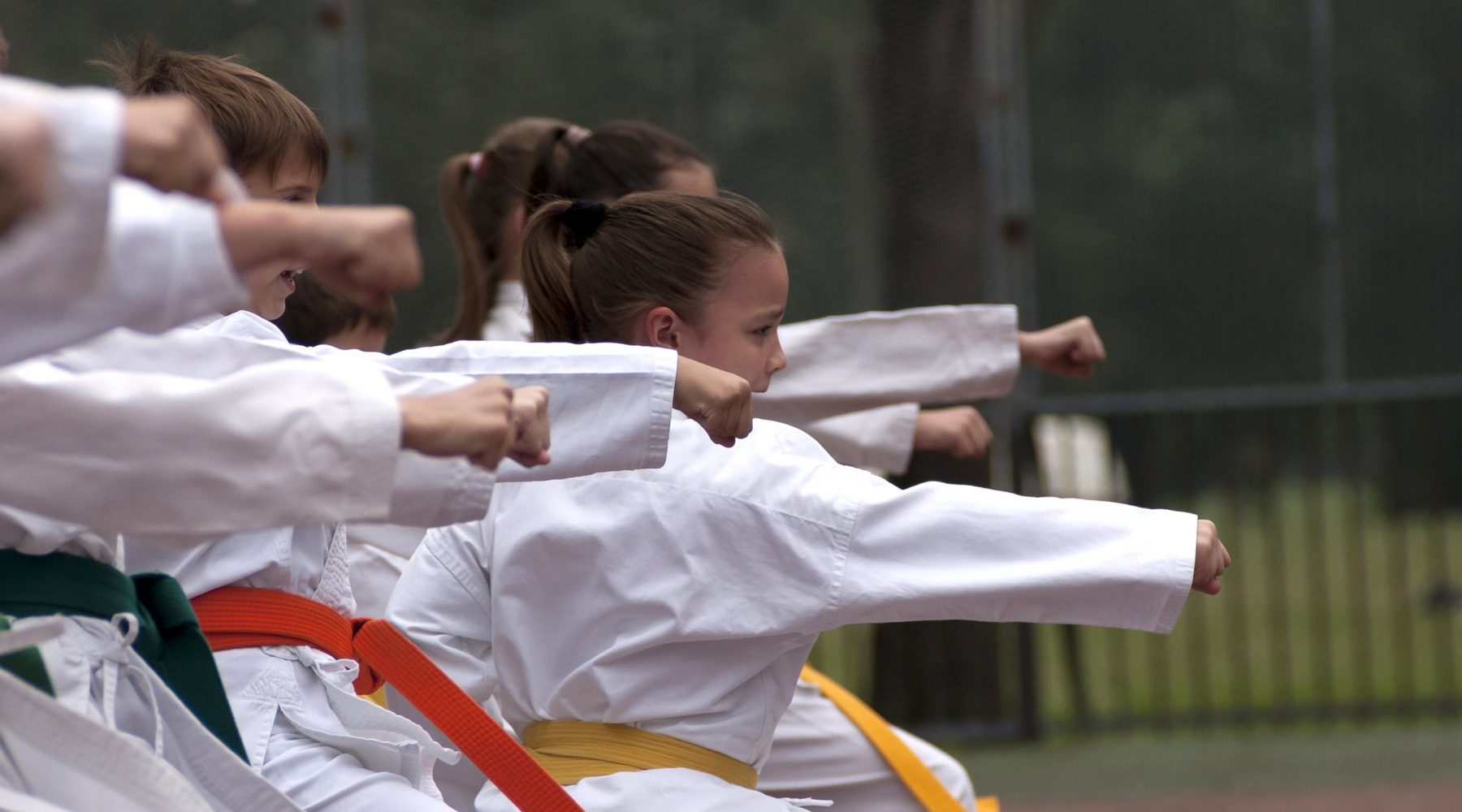
The class lines up by grade, bows in, and warms up with running, stretching and games that are really coordination drills in disguise. Your child will be put next to someone who knows what they are doing.
Basics, in short bursts
Punches, blocks, kicks and stances, taught a few at a time and repeated. Pad work so they get to hit something. Nobody is sparring in their first weeks, and nobody is made to do anything they are not ready for.
Bowing out
The class lines up again, and the instructor will usually say something about what went well. Then they come and find you, generally talking rather fast about what they just learned.
What it does, beyond the kicking
Almost nobody enrols a five-year-old because they want them to be good at fighting. They come because their child is shy, or will not sit still, or has been having a hard time at school, or simply needs something to do on a Tuesday that is not a screen.
- Listening — instructions are given, and the class is expected to follow them
- Confidence — earned by actually getting better at something difficult
- Respect — for the instructor, for the people they train with, and for the people they could hurt
- Self-control — this is at the core of everything we teach
- Coordination and fitness — without it feeling like exercise
- A goal they can see — the next belt is always a realistic distance away
On bullying
We are asked about this constantly, and a good deal of what we teach is aimed squarely at it. Most of it is not fighting. It is standing and speaking in a way that does not read as an easy target, keeping your distance, staying where other people are, saying no and meaning it, getting out of a grab or a hold and walking away, and knowing who to tell and how to tell them. Children who train tend to carry themselves differently within a few months, and that on its own heads off a great deal before it starts. We are equally plain that using any of this outside the hall, other than to get yourself away from harm, is the fastest way to be asked to leave it.
What to bring
A T-shirt, jogging bottoms, bare feet and a bottle of water. That is genuinely it. No suit, no equipment, nothing to buy before you know whether they like it. If they carry on, you will need a gi and a licence, and the instructor will sort both out with you — there is no rush and no sales pitch.
Classes for children near you
Pee Wee classes — from age 4
Separate hour-long sessions, run before or apart from the main class. Small groups, a lot of repetition, and games used deliberately to teach coordination.
Junior classes
For children who have outgrown the Pee Wees but are not yet training with the adults.
Clubs children train at alongside adults
Mixed-grade, mixed-age sessions. This is how Wado Ryu has always been taught here — and it is why families often end up training together.


The questions we get most
What age can my child start?+
Our Pee Wee classes take children from four. Those run separately from the main sessions in shorter blocks. From around ten, most children move into the main class alongside teenagers and adults. If your child is on the boundary, ask the instructor — they would rather place them correctly than have them in the wrong room.
Can I stay and watch?+
Ask the instructor at your club. Some halls have room for parents to sit in and some do not, so it varies from venue to venue.
Does my child need a suit to start?+
No. A T-shirt, jogging bottoms and bare feet are fine. Buy nothing until you both know they want to carry on — then the instructor will sort out a gi and a licence with you.
Will my child get hurt?+
Karate is a contact sport and bumps happen, as they do in football. Junior classes are supervised closely, contact is controlled, beginners are not thrown into sparring, and every instructor is first aid trained and insured.
My child is very shy. Is this a bad idea?+
It is usually the opposite. Shy children often do well because the structure is so clear — you always know where to stand, what to do and what happens next. Progress is visible, which builds confidence faster than being told to be confident.
What if they hate it?+
Then you have lost an hour and nothing else. The first session is free, there is no contract and no joining fee, and you pay per session after that. Nobody will chase you.
How much does it cost?+
You pay for the sessions you attend, on the night. There is no joining fee, no monthly direct debit and no minimum term. An annual licence is charged separately once your child decides to continue.
How quickly will they get a belt?+
Kyu gradings run roughly every three to four months across the association. Your child grades when their instructor judges they are ready, not on a schedule — the belt means something because of that.
Are the instructors checked?+
Every WYSOK instructor holds an enhanced DBS certificate, current first aid training and full insurance through our NAKMAS affiliation.
Do classes run in the school holidays?+
It varies by club. Ask your instructor, or check the club page — term-time and holiday changes are announced in class and on the club's Facebook page.
Let them try it for nothing
One free session, no kit and no contract — just bring them along and see how they get on.