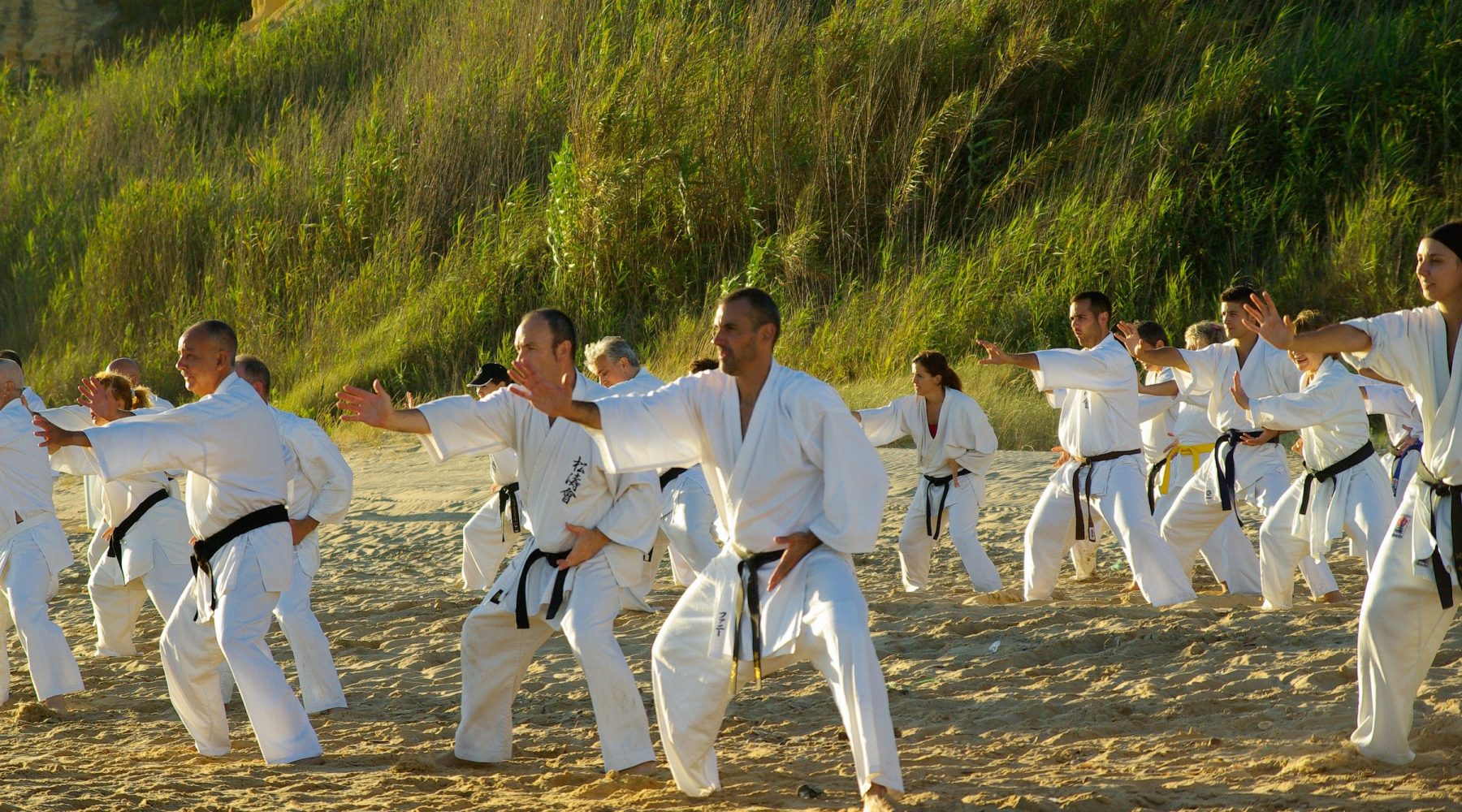
Mu Chindo Karate
No mind — acting without stopping to think
Mu Chindo means “no mind way”: a way of fighting that allows immediate action without conscious thought. It is one of the few Okinawan styles to have come through the last century largely unchanged, and in this country it is now all but extinct.
Mu Chindo — also written Mu Shindo — is an old Okinawan karate style whose roots go back hundreds of years. The name translates as “no mind way”, and that is a description of the goal rather than a piece of decoration. A fighter who feels no anger, no fear and no ego has nothing in the way: there is no running commentary, no deciding what the next move ought to be, and so no hesitation between seeing and doing. What is left is what the body already knows.
Most karate styles have been changed and adapted over the last hundred years. Mu Chindo is one of the few that has been left largely as it was, which is much of the reason it is worth preserving — and much of the reason it is now so rare. In the United Kingdom it is all but extinct.
Shihan Ann Walker studied Mu Chindo alongside Wado Ryu, and was determined that it should not be lost. Keeping it taught, graded and passed on inside WYSOK is one of the more unusual things this association does, and one of the things it is most serious about.
On paper the syllabus looks familiar: technique, kata and kumite, much as in Wado Ryu. In the hall it feels nothing like it. The applications are different, and so is the shape of the movement — Mu Chindo asks for speed and power together, and most of its stances are short, which is what makes that speed possible. It also carries things the empty-hand syllabus does not: pre-arranged sparring, bo jutsu technique, knife work, and defences against several attackers at once.
Mu Chindo is open to any WYSOK member at 6th Kyu and above. It is taught through courses run across the association rather than at a single club, with gradings alongside them — the news page carries the dates of the next one.
What you learn
- Kata — many of the forms you would meet in other karate styles, done with key differences
- Technique — the basic kicks, punches and blocks the style is built upon
- Kumite dachi — the short stance everything else works from. Difficult to pick up, and considerably faster once you have it
- Sanbon kumite — pre-arranged sparring: a set sequence learned, and performed at grading
- Kata kumite at slow speed, and jiyu kumite at full
- Two-on-one sparring for the higher grades
- Defences against multiple attackers, both armed and unarmed
- Defences from kneeling and from seated, where you cannot simply move away
- Bo jutsu technique and knife fighting
Who it suits
Graded students who already have the empty-hand basics and want something older, rarer and harder. The multiple-attacker work is the part people remember: a line of anything from three to ten attackers is sent in one at a time, on the clock, so a defender who takes too long over one of them finds the next arriving behind — and a student who struggles can end up with a queue. It rewards composure more than strength, which is rather the point of the name.
Grading & belts
Mu Chindo has its own grading syllabus, run through association courses rather than at club level, and is open from 6th Kyu upwards. Courses and gradings are held regularly — watch the news page for the next date.
Add Mu Chindo Karate to your training
It is taught through courses run across the association and is open to graded WYSOK students. Course and grading dates go up on the news page. If you are not training with us yet, a club is the place to start.